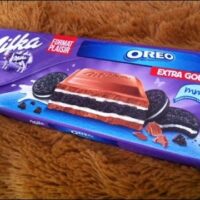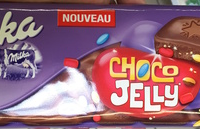
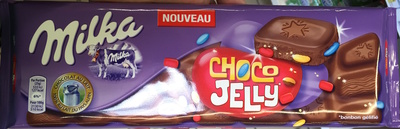
Milka Choco Jelly
Chocolate Milk du pays Alpin with des bonbons gélifiés (7%), des dragées Cocoatées Colorées (6%) and des granulés effervescents (4%)
- Estimated Delivery : Up to 4 business days
- Free Shipping & Returns : On all orders over $200
Description
Choco Jelly
Chocolate Milk from the Alpine country with gummies (7%), Colored Cocoa dragees (6%) and effervescent granules (4%)
Barcode: 7622210226969
Certified as:
Ingredients: Sugar, Cocoa Butter, Powder from Skimmed Milk, Cocoa Paste, Whey Powder (de Milk), beurre Concentrate, Glucose Syrup, Syrup fromSugar inverti, Lactose (de Milk), Dextrine Corn, pâte from Noisettes, Emulsifier (Soy L:ecithin), Cocoa maigre Powder, Dextrose, Milk entire Powder, agents d’enrobage (gomme arabique, cire d’abeille White and jaune, shellac, cire from Carnauba), Food Colorings (anthocyanes, bêta-carotène, dioxyde from Titane, Red from Betterave, riboflavine, oxydes and hydroxydes from Fer), Aromas, Acidifiant (Citric Acid), dioxyde from Carbone.
Shipped from: France – France
Manufacturer:
Milka
Available at the following stores:
Weight: 250 g
Serving size: 25 g
Food Traces: Nuts / Autres Fruits à coque
Number of additives / E-numbers: 14 – e101,e101i,e1400,e160a,e160ai,e162,e163,e171,e172,e290,e322 (Soy lecithin E322 is generally safe food additive. Because it’s present in such small amounts in food, it’s unlikely to be harmful. Though evidence supporting soy lecithin as supplement is somewhat limited, the evidence backing choline could steer people toward this food additive in supplement form),e322i (Some Lecithin contains egg yolks so not suitable for Vegans. Other main sources of Lecithin are from soya Bean oil and is likely to be genetically modified if sourced from countries such as the US. Lecithin can also be directly obtained from animal fat),e330 (Citric acid is compound found in every living organism, as it is part of the key metabolic pathways in all body cells. Large concentrations are found in citrus Fruits, kiwi, strawberries and many other Fruits. It is commercially prepared by fermentation of molasses with the mould Aspergillus niger. Citric acid has many functions – it enhances the activity of many antioxidants, but is no antioxidant by itself. It is mainly used as an acidity regulator as well as aroma compound. It increases gel strength in marmalades and decreases enzymatic browning in Fruits and Fruit products. Citric acid and citrates can normally be consumed by Muslims, Vegans and Vegetarians. Citric acid does not cause allergic reactions in people who are allergic to oranges and citrus Fruits, as it is commercially made from sugar, not Fruits.), e414,e901,e903,e904
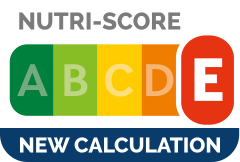
National Nutrition Category:Sugary Snacks / Chocolate products
Nutrition Facts:
Brand
Kraft
Milka
Milka is a brand of chocolate confectionary, originally made in Switzerland since 1901 by Suchard. It has then been produced in Lörrach, Germany for the past 100 years. Since 2012 it has been owned by US-based company Mondelez International, when it started following the steps of its predecessor Kraft Foods Inc., which had taken over the brand in 1990. It is sold in bars and a number of novelty shapes for Easter and Christmas. Products with the Milka brand also include chocolate-covered cookies and biscuits.
European Milka varieties
Alpine Milk, Grapes and Nuts, Strawberry, Milka and LU Cookies, Peanut Crisp, White Chocolate and Oreo, Milka an Oreo-Sandwich, Triple Choco Cocoa, Colorful Chocolate Lentils, Milka and TUC-Cracker, Milka and Daim, Noisette, Whole Hazelnuts, Cow Spots, Yogurt, Broken Hazelnuts, White Chocolate, Caramel, Dark Chocolate, Luflée, Alpine Milk Creme, Whole Hazelnuts, Strawberry Cheesecake, Almond Caramel, Peanut Caramel, Milka and Oreo, Chocolate Cookie, Toffee Whole Hazelnut, Alpine Milk, Noisette, Triple Choc, Luflée Caramel, Nut Nougat Creme, Crispy Yogurt, Broken Hazelnut, Cocoa Splinter, Dark Alpine Milk, Salted Caramel, Almond and Raspberry.[embed]https://www.youtube.com/embed/YuS33oyz6wc[/embed]
Mondelez
Deforestation
In September 2017, an investigation conducted by NGO Mighty Earth found that a large amount of the cocoa used in chocolate produced by Mondelez and other major chocolate companies was grown illegally in national parks and other protected areas in Ivory Coast and Ghana. The countries are the world's two largest cocoa producers.The report documents how in several national parks and other protected areas, 90% or more of the land mass has been converted to cocoa. Less than four percent of Ivory Coast remains densely forested, and the chocolate companies' laissez-faire approach to sourcing has driven extensive deforestation in Ghana as well. In Ivory Coast, deforestation has pushed chimpanzees into just a few small pockets, and reduced the country's elephant population from several hundred thousand to about 200–400. While Mondelez claimed to have mapped almost all of its cocoa suppliers in Côte d'Ivoire, Ghana and Indonesia by 2018 in an effort to combat deforestation. Mondelez received a 'yellow', the second of the four possible ratings on the 2022 Chocolate Scorecard for Agroforestry i.e. 'starting to implement good policies'. In November 2018, an investigation by Greenpeace International found that 22 palm oil suppliers to Mondelez International cleared over 70,000 hectares (170,000 acres) of rainforest from 2015 to 2017.
Halal Status



- Sucre 52.4 % (estimate)
- beurre de cacao 23.8 % (estimate)
- poudre de lait écrémé 11.9 % (estimate)
- pâte de cacao 6 % (estimate)
- lactosérum en poudre 3 % (estimate)
- beurre concentré 1.5 % (estimate)
- sirop de glucose 0.7 % (estimate)
- sirop de Sucre inverti 0.4 % (estimate)
- lactose 0.2 % (estimate)
- dextrine de blé 0.1 % (estimate)
- pâte de noisettes 0 % (estimate)
- émulsifiant 0 % (estimate)
- — lecithine de soja 0 % (estimate)
- cacao maigre en poudre 0 % (estimate)
- dextrose 0 % (estimate)
- lait entier en poudre 0 % (estimate)
- agents d'enrobage 0 % (estimate)
- — gomme arabique 0 % (estimate)
- — cire d'abeille blanche et jaune 0 % (estimate)
- — shellac 0 % (estimate)
- — cire de carnauba 0 % (estimate)
- colorants 0 % (estimate)
- — anthocyanes 0 % (estimate)
- — bêta-carotène 0 % (estimate)
- — dioxyde de titane 0 % (estimate)
- — rouge de betterave 0 % (estimate)
- — riboflavine 0 % (estimate)
- — oxydes et hydroxydes de fer 0 % (estimate)
- arômes 0 % (estimate)
- acidifiant 0 % (estimate)
- — acide citrique 0 % (estimate)
- dioxyde de carbone 0 % (estimate)
- Cacao 0 % (estimate)
- — pays alpin 0 % (estimate)
| Energy | 2130 kJ |
|---|---|
| – kcal | |
| Fat | 25.5 g |
| Saturated fat | 15 g |
| Carbohydrates | 63 g |
| Sugars | 60.5 g |
| Fiber | 1.7 g |
| Proteins | 5.6 g |
| Salt | 0.4 g |
| Fruits, vegetables & nuts (estimate) | 0 % |
Related Food Products

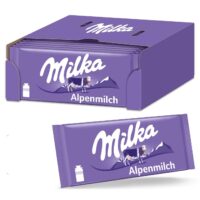
Milka Alpenmilch
€1,65
Hazelnut Milk Chocolate
€2,29
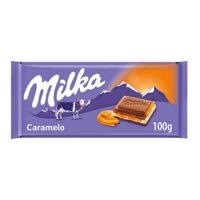
Milka Choco Caramel
€2,10Chocolate Whoppers
€1,68Milka Chips Ahoy
€1,65Milka Chocolate Hearts
€7,90Swiss Milk Chocolate
€2,29Merci
€4,29Milka Oreo
€1,29Milka LU Cookies
€7,42Dairy Milk Freddo faces
€1,85Milka Chocolate Granola
€1,85